
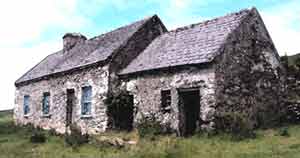
When people speak of the Great Famine in Ireland, they usually mean the years from the mid-1840s to the early 1850s, when repeated failure of the potato crop pushed a large part of the rural population into hunger, disease and emigration. Few places show the pattern as clearly as the western seaboard of County Kerry, where small farms, poor land and a heavy reliance on a single crop left families with almost no margin for error.
A diet built on one crop
By the early nineteenth century, the potato had become the main food of many Irish households, especially among tenant farmers and labourers who held only a few acres. It grew well in thin, damp soil, produced a high yield from a small plot and could feed a family through the year when stored carefully. Often a second variety was grown to feed pigs or cattle. In the Dingle Peninsula, that meant raised ridges, often called “potato beds”, fertilised with animal manure and seaweed carried up from the shore.
The system worked as long as the harvest held. Its weakness was that nearly everything depended on it. When blight struck, there was no second staple to turn to.
Why the west suffered so much
Several features made the far west especially vulnerable:
- Tiny holdings. Plots were so small that families could not build up savings or grow other crops in meaningful quantities.
- Rent and landlord systems. Tenants owed rent on land they could barely work, and many estates were managed by agents rather than owners living nearby.
- Isolation. Mountains and poor roads made it hard to move food or relief into remote townlands.
- Limited alternatives. Fishing and seasonal labour helped some households, but they rarely replaced the lost harvest.
Hunger, disease and leaving
Historians generally estimate that around a million people died and a similar number emigrated during and just after the Famine years, although exact figures remain debated. Much of the death toll came not from starvation alone but from illnesses such as typhus and dysentery that spread among weakened people in crowded workhouses, lanes and makeshift shelters.
Emigration, which had existed before, became a flood. Families sold what they had, or relied on money sent back by relatives, to book passage across the Atlantic. For many the departure point was a nearby port, and the journey by sailing ship was difficult. The decline in population in places like West Kerry left empty cottages that can still be found on hillsides today.
Buildings as evidence
Written records of the period are uneven, so physical remains matter. Ruined or preserved stone houses, outbuildings for animals, field walls and burial plots all help tell the story. A farmhouse with a later slate roof, a cowhouse added when holdings grew, or a small family burial ground set apart from the churchyard each records a particular chapter of local life.
Burial practice is one example. In that period, children who died unbaptised were often not permitted burial in consecrated ground, so families laid them to rest in unmarked or simply marked places on their own land. Such small cairns and cross-marked plots survive in several parts of western Ireland.
Remembering responsibly
Understanding the Famine means holding two ideas together: that natural disease destroyed the crop, and that social and political conditions shaped how many people died. Good local history avoids shortcuts. It looks at who owned the land, what relief existed, what people ate when the potatoes failed, and how communities coped or left.
For anyone interested in the subject, local folklore collections, parish records and the buildings themselves are valuable starting points. Reading them together shows how a national catastrophe was lived in individual households, one winter at a time.